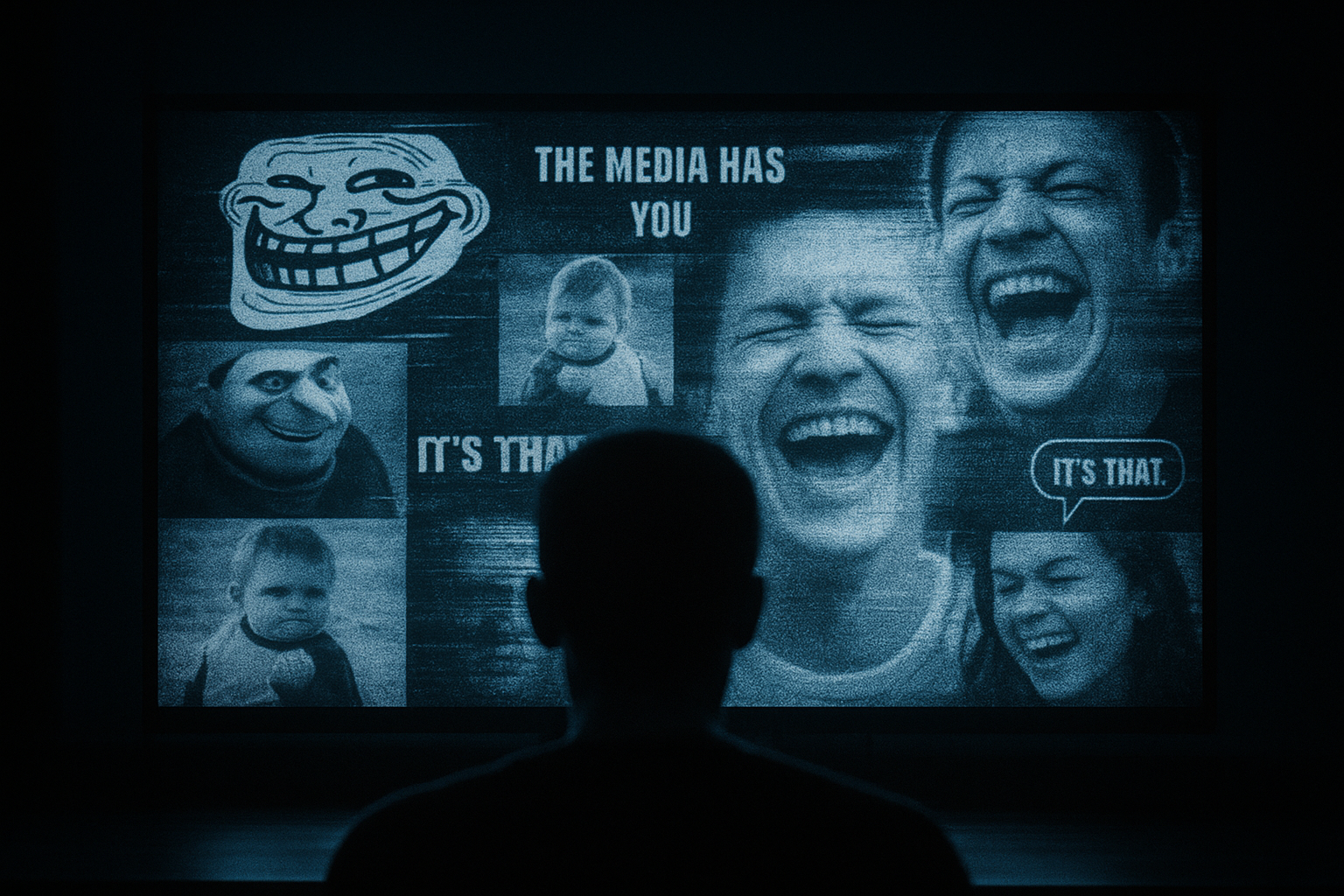
The Moment You Stopped Following an Idea
There’s a specific moment worth noticing, if you can catch it. It’s the moment you stop asking “do I agree with this” and start asking “would they agree with this.” Somewhere along the way, the object of your attention changed. You used to follow a philosophy, a diet, a political stance, an aesthetic. Now you follow a person, and the philosophy just comes bundled in, like terms and conditions nobody reads.
This isn’t a small shift. When belief attaches to an idea, you can drop the idea without losing anything but the idea. When belief attaches to a person, dropping it means admitting you misjudged someone you liked, maybe someone you felt genuinely close to, even though you’ve never met them and never will. That admission costs more. Which is exactly why so few people make it, even when the evidence piles up.
Parasocial relationships used to be a footnote in media psychology, mostly used to explain why people cried when a sitcom character died. Now they’re the operating system of the internet. And an operating system, once installed, tends to run in the background whether you notice it or not. You don’t consciously decide to adopt a creator’s stance on parenting, or nutrition, or geopolitics. It just arrives, absorbed the same way you absorb an accent from the people you spend the most time around. Except the people you spend the most time around, in this case, are speaking to a camera and have never spent a minute around you.
How a Following Becomes a Faith
Faith communities have always understood something that platforms figured out later: belonging is stickier than believing. You can disagree with your church on plenty and still show up every Sunday, because what keeps you there isn’t the theology, it’s the people, the ritual, the sense of being known. Influencer culture reproduces this structure almost exactly, just without the building.
The daily video, the consistent aesthetic, the recurring catchphrases; these aren’t content, they’re liturgy. They create the rhythm that faith runs on. Erving Goffman would have recognized the whole apparatus instantly. He spent a career describing how people perform a coherent self for an audience, carefully managing front stage and back stage. Influencers have simply industrialized the front stage and monetized the illusion of occasional backstage access, the “vlog where I show you the real me,” which is, of course, also a performance.
What makes this dangerous isn’t the performance itself. Performance is old news; humans have always curated. What’s new is scale and intimacy arriving together. A pastor speaks to a room. An influencer speaks, seemingly, to you alone, through a phone six inches from your face, using the specific vocal cadence platforms have taught creators to use because it mimics the tone of a close friend. Your nervous system doesn’t fully distinguish between a friend and a very convincing simulation of one. So it responds like it’s real. Because, in a felt sense, it is.
There’s also a subtler ritual element worth naming: the comment section. Faith traditions have congregations who affirm each other’s belief out loud, in unison, on a schedule. Influencer audiences do something structurally similar every time a post goes up. Thousands of strangers, publicly agreeing, publicly signaling belonging, publicly punishing dissent in the replies. Nobody designed it to function like a congregation. It just does.
The Loyalty That Feels Like Self-Defense
Here’s where it gets uncomfortable. Once someone’s worldview has been absorbed through a person rather than an argument, criticizing the person starts to feel like an attack on you. Not on your opinions. On you.
Robert Cialdini’s research on influence explains part of the mechanism: liking is one of the strongest predictors of persuasion, stronger in many cases than logic or evidence. We don’t evaluate claims neutrally once we like the source. We reverse-engineer justifications for what we already want to believe, because the source has become a stand-in for our own identity. Defend the influencer, defend yourself. Attack the influencer, and something in you flinches like it’s personal, because by this point, it is.
This is why disagreements about influencers online rarely look like disagreements. They look like tribal skirmishes, complete with the language of betrayal, loyalty, and heresy, even when the actual disagreement is about, say, whether someone’s supplement claims hold up to scrutiny. Nobody’s discussing supplements anymore. They’re discussing whose side you’re on.
You can watch this play out almost identically across completely different corners of the internet: wellness influencers accused of pseudoscience, finance influencers accused of running thinly veiled pyramid schemes, political commentators accused of quietly softening on positions they once built their entire brand around. The subject matter changes. The defense pattern doesn’t. Someone produces evidence. The audience doesn’t engage with the evidence. It engages with the accuser, questioning motives, questioning credentials, questioning why anyone would want to tear down someone doing so much good. The evidence becomes almost incidental to the exchange.
Frantz Fanon wrote about identification with a figure of power as a psychological survival strategy under conditions of powerlessness, and while the contexts are worlds apart, there’s an uncomfortable echo here. When people feel unmoored, economically precarious, socially isolated, politically unrepresented, attaching to a confident, coherent figure who seems to have it all worked out isn’t irrational. It’s a reasonable response to an unreasonable amount of uncertainty. The problem isn’t that people want certainty. The problem is who gets to supply it, and what they do with the trust once it’s handed over.
The Algorithm Didn’t Create This, But It Loves It
None of this required social media to exist; cults, charismatic preachers, and populist leaders proved the pattern centuries before the first smartphone. What social media did was remove the friction. You used to have to physically show up somewhere to be discipled into a worldview. Now it arrives through a feed engineered to maximize time spent, and time spent correlates strongly with emotional intensity, and emotional intensity correlates strongly with, well, feeling close to someone.
Platforms don’t have an opinion about whether parasocial attachment is healthy. They have an opinion about whether it’s engaging, and it turns out those two things pull in opposite directions more often than not. A creator who cultivates a devoted, ideologically loyal audience produces more comments, more shares, more of the specific kind of algorithmic heat that gets rewarded with reach. Shoshana Zuboff has described this as a system that doesn’t just observe behavior but shapes it for profit, and few behaviors are as reliably profitable as belief.
So the incentive structure quietly favors influencers who function less like commentators and more like leaders of small, distributed movements. Not because any single platform planned it that way. Because it works, and things that work get amplified until they stop looking like an accident and start looking like the architecture itself. The most successful creators, whether or not they intend to, learn to speak in the cadence of a movement leader: us versus them, the mainstream lying to you, only I will tell you the truth. It converts well. Conversion has never cared much about whether the thing being converted to is true.
What Happens When the Person Behind the Ideology Falls
Eventually, most idols disappoint. They get caught in a lie, a scandal, a change of position that contradicts everything they built their following on. And what follows is often more revealing than the scandal itself.
Some followers leave immediately, relieved almost, like they’d been waiting for permission. Others double down, reinterpreting the evidence, calling it a smear campaign, insisting the person they trusted couldn’t possibly have changed because their whole identity was staked on that trust being correct. Antonio Damásio’s work on the somatic marker hypothesis offers a clue here: our decisions are steeped in bodily, emotional signals long before conscious reasoning gets involved. Unwinding a belief that’s tangled up with genuine emotional attachment isn’t a logic problem. It’s closer to grief, and grief resists tidy conclusions.
There’s a pattern to the doubling down, too. It tends to arrive with a specific vocabulary: “context,” “nuance,” “you don’t know the full story.” All of which can be true. Sometimes it genuinely is context, and the pile-on is unfair. But the same vocabulary shows up whether the accusation is accurate or not, because the function of the vocabulary isn’t to evaluate the claim. It’s to buy time for identity to catch up with new information it isn’t ready to accept yet.
The Question Worth Sitting With
Maybe that’s the real diagnostic question. Not “is this person trustworthy,” which is useful but incomplete, but “what would it cost me, personally, to find out they aren’t.” If the honest answer feels bigger than it should, for someone you’ve never actually met, that’s probably worth a second look.
Not because admiration is the problem. Admiration is fine. Following someone’s work, learning from them, even feeling genuinely fond of a creator you’ve watched for years, none of that is the issue. The issue is the quiet moment where admiration stops being about them and starts being about you, where their credibility becomes load-bearing for your own sense of who you are and what you believe. Somewhere along the way, admiration quietly filed the paperwork to become belief, and nobody remembers signing anything.